


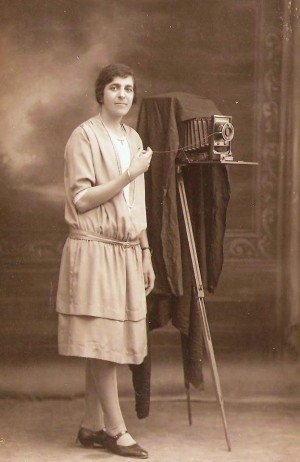
The Palestinian Karimeh Abbud (1896-1955): First woman photojournalist in the Arab world
By Iqbal Tamimi
The difficult
circumstances in Palestine facing journalists in the occupied West Bank and
Gaza forced many media establishments to choose employing local journalists who
know the nature of the area, besides minimizing the amount of risks reporters
and photojournalists face when covering clashes between Israelis and
Palestinians in the Gaza.
This article will focus
on Palestinian women photojournalists working within the Palestinian
territories; thus excluding hundreds of Palestinian women journalists who are
working all over the world after their families became refugees, or forced to
exile.
Early photography in
Palestine
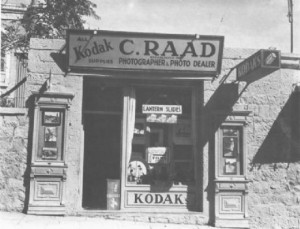
Photojournalism started
after photography was introduced to Palestine in the late-nineteenth century by
the British who undertook the first archaeological excavations in the Holy Land
and tried to document their findings and the areas they investigated by pictures
as Rachel Hallote reported (2007 pp 26-41). The British were followed by the
Germans, and eventually by the Americans. Photography was introduced by people
who came searching for evidence about biblical subjects and connections. Some
elder Palestinians claimed that these excavations were part of a planned agenda
to pave the way for the Jews to occupy Palestine well ahead the Nazi’s
aggression on the European Jews. Americans were deeply involved in the
archaeological photography in Palestine, but the British Palestine Exploration
Fund dominated the photography activities in Palestine since the 1860s.
Photojournalism in Palestine is considered a male dominated profession as is the case in almost all Middle Eastern countries, but Palestine has always been the first country within the Arab world to offer women the opportunity to be in the lead to break old social moulds when it comes to pioneering work and education for women. As an example the first Arab woman to hold an academic title as a professor and to establish an institute in a western country was the Palestinian Kulthum Odeh (1892 -1965) as Tamimi (2008) reported.
During the same period
another woman from the same city of Nazerath named Karimeh Abbud (1896-1955)
was the first Palestinian woman to become a professional photographer. Karimeh
lived and worked in Palestine in the first half of the twentieth century,
research shows that she might have been the first female professional
photographer not just in Palestine but in the entire East. Karima had her education
in Nazareth, and at the Schmidt Girls School in Jerusalem, and the American
University of Beirut in Lebanon.
Ahmed Mrowat (2007 p
72-78) reported that Abbud started photography in 1913 in Bethlehem after
receiving a camera from her father as a gift for her 17th birthday. Her first
photos were of family, friends and the landscape in Bethlehem. Her first signed
picture available at present is dated October 1919. She started by setting up a
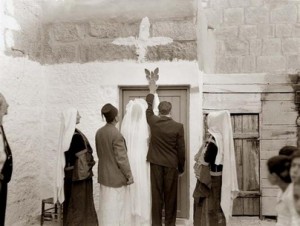
home studio, earning money by taking photos of women, children, weddings and
other ceremonies. She also took numerous photos of public spaces in Haifa,
Nazareth, Bethlehem and Tiberias. When local Nazareth photographer Fadil Saba
moved to Haifa 1930, Karimeh’s studio work was in high demand. The work she
produced in that period was stamped in Arabic and English with the words:
“Karimeh Abbud – Lady Photographer. She took photos of areas that have
religious significance like Kafr Kanna in the Galilee associated with the Cana
village where Jesus biblical stories claimed he turned water into wine. This
village flourished in the 16th century, as it lay on the trade route between
Egypt and Syria. Karimeh also took pictures of Mary’s Well near Nazareth or
“The spring of the Virgin Mary”) which is reputed to be located at the site
where the Angel Gabriel appeared to Mary and announced that she would bear a
son. The well was positioned over an underground spring that served for
centuries as a local watering hole for the Arab villagers.
In the mid-1930s, she
began offering hand-painted copies of studio photographs. In a 1941 letter to
her cousins, she expresses her desire to prepare a publicly printed album for
her photographic work. According to Mrowat (2007) Karimeh ultimately returned
to Nazareth, where she died in 1955. Original copies of her extensive portfolio
have been collected together by Ahmed Mrowat, Director of the Nazareth Archives
Project. In 2006, Boki Boazz, an Israeli antiquities collector, discovered over
400 original prints of Abbud’s in a home in the Qatamon quarter of Jerusalem
that had been abandoned by its owners in 1948. Mrowat has expanded his
collection by purchasing the photos from Boazz, many of which are signed by the
artist.
While Palestinian male
photojournalists started few years earlier than Karimeh as Nassar reported
(2006 pp. 139-155) it was Yessayi Garabedian the leader of the Armenian
Patriarchate in Jerusalem who started the first photographic workshop in
Palestine. One of Garabedian’s pupils was the famous Garabed Krikorian as
Ankori (2006 p36) reported that he established his photographic studio in the
Old City of Jerusalem and worked in it from 1885 until 1948. Krikorian was
entrusted to prepare the famous Sultan Abdul Hamid Albums on Palestine and
later became the official photographer of Kaiser Wilhelm II during his visit to
Palestine in 1899. Krikorian worked in his workshop for over forty years. His
son Johannes travelled to Cologne in Germany to further his photographic
training and came back after years of study and training to become the
preeminent studio photographer in Jerusalem.
Another of Garabed’s
students was Khalil Raad who opened his studio in 1890, across the street from
the Krikorian studio, leading to intense competition between the two pioneering
photographers. Peace was found when Raad’s niece, Najla Raad was betrothed to
Johannes Krikorian and she became known as the peace bride. But unfortunately
the historic photographic studio was tragically destroyed in 1948 by the Jews
during their attacks on the city.
Palestinian women
photojournalists now
I requested some information
from The Palestinian Central Bureau of Statistics in the Palestinian
Authorities for (2008) regarding the percentage of female Palestinian
photojournalists registered officially, the Palestinian authorities statistics
built its findings on ownership documents of photography studios showing that
there are 201 Palestinian female photographers in the West Bank of a total of
984 photographers, 783 are males. This statistic was obtained from officially
registered studios excluding the number of photographers in Gaza where it is
difficult to obtain statistics by the Palestinian Authorities, besides there is
a number of journalists who are not registered officially. A female
photojournalist in Gaza Eman Mohammed explained to me the amount of social
difficulty she faced for stepping in a male’s territory, she also expressed her
determination to overcome obstacles as she said “going to take photos at
invasions, airstrikes, violent demonstrations, and hot zones seemed like the
only way to prove to everyone that I can handle this job, but I could never go
there without getting verbally offended or harassed”.
Eman mentioned violent
demonstrations, invasions, and airstrikes for her subjects unlike the subjects
documented by Karimeh, because she had no other choices for such subjects are
part of everyday life in Palestine. Should she had another choice maybe she
would choose to take photos of fashion shows or festivals, art galleries or
anything that is not related to death and destruction, but this is her city and
this was the hard reality she had to face.
During the Visa pour
l’image international photojournalism festival in Perpignan, France, from
August 29 to September 11, 2005 Jack Crager (2005 p10, 15) reported that the
exhibitions featured reflected individual photographers’ efforts to highlight
major trends, during the exhibition all three participating Palestinian
photographers’ images were of funerals in the Gaza Strip. Burgess (1994 p20-22)
also reported that during the 1994 World Press Photo annual awards in Amsterdam,
the top award went to Larry Towell’s image of Palestinian boys playing with
guns for the camera. Palestinian photojournalists do not only witness and
document attacks, they become sometimes part of such bigger picture. Smyth
(2005 p12-14) wrote a feature article about three Palestinian photojournalists
and brothers based in the Gaza strip who are employed by Reuters. Smyth
reported that their work regularly takes them to scenes of chaos and
destruction in which they are sometimes, inevitably, involved and face the
possibilities of injury, she wrote of Jadallah one of the three Palestinian
brothers photographers being injured four times through his work, and she
reported on the more tragically still, funerals they have to cover that is
often involve friends and relatives. Smyth argues that their intimate knowledge
of Gaza that allowed the brothers to take photographs different to those of
Western photographers based in the area. Sure if you are part of a place you
would see things differently because you are not only doing your job, you are
affected by what you are trying to capture from another angle, you are not
totally independent of your emotions.
Eman like almost all
other Palestinian photojournalists could not get official training so she was
trained as an individual by several photojournalists, and she had to convince
her community that photography was only ‘just a hobby, not a lifetime career’
to escape more scrutiny. She had worked for different agencies for free just to
have her pictures published.
Unlike Eman, Enas Mraih
another Palestinian female photojournalist she was lucky to work with Alhadath
newspaper published in Palestinian territories occupied 1948 called now
‘Israel’. She was invited to Denmark to participate in a workshop with 28 other
journalists from 6 countries: Egypt, Jordan, Yemen, Occupied Palestinian
territories of 1967, Besides Israel and the country host. Enas was even chosen
to be on the cover of ‘Crossing Borders’ a magazine published in Denmark and
circulated in the Arab world. Enas was accompanied by another two Palestinian
women photojournalists; they were Kholoud Masalhah, and Qamar Thaher. Enas was
more fortunate than other female Palestinian photojournalists in being able to
participate few times in conferences to discuss the Palestinian Israeli
conflict, and the struggle of Palestinians fighting for the right to be treated
equally like Jewish citizens living in the same state holding the same
Citizenship, but still suffer racial discrimination by the Israeli government
for being Israeli Arabs.
Laila Abu Odeh is another
female photojournalist working in Rafah who was a victim of aggression by
Israeli forces; she was shot in her thigh by the Israeli soldiers while filming
the destruction caused by the Israeli shelling of The Rafah Camp near Salah
Eddin Gate on the 20th of April 2001.
Palestinian women started
taking pictures of families and holy places, ceremonies and weddings because
this was part of every day life, but ended up taking pictures of bodies of
killed young children, shelled schools and homes, and lots of blood including
their own for the same reason. Having been living in an area where everything
is disputed including the rights of journalists, there are no institutions
those women can request assistance from for training or protection. They are
women armed with cameras chasing the truth no matter what the consequences are.
Some of them end up in jail like Isra’a el-Amarna the photojournalist from
Dheisheh refugee camp who has been detained by the Israeli occupation
authorities. Isra’a was working in photography to support her poor family when
the Israeli occupation authorities arrested her on accusation of membership to
Qassam Brigades, and that she had the intention to carry out a martyrdom
operation. A camera is as powerful as a gun but those who use cameras are not
the coward ones.
Photoes included are by
the Palestinian photojournalist Karimeh Abbud (1896-1955)
Bibliography
Katz, Lee M. (2000) Life,
limb, & a deadline to meet Editor & Publisher 11/20/2000, Vol. 133
Issue 47, p14
Hallote, R. (2007)
Photography The American Contribution To Early Biblical Archaeology 1870-1920.
Near Eastern Archaeology 70 no1 pp 26-41
Tamimi, I. (2008) The
Palestinian Kulthum Odeh (1892 -1965) the first woman to hold the professor
title in the Arab world, London Progressive Journal. Issue 41 October 2008
Mrowat. A (2007) Karimeh
Abbud: Early Woman Photographer (1896-1955) Jerusalem Quarterly (Institute of
Jerusalem Studies) Issue 31: p. 72-78
Mrowat, A (2007)
Photography As Ethnographic History. Depiction of Israeli-Palestinian Conflict
since 1948, The Institute of Jerusalem Studies.
Nassar, I. (2006)
Familial Snapshots: Representing Palestine in the Work of the First Local
Photographers History & Memory – Volume 18, Number 2, Fall/Winter 2006, pp.
139-155 Indiana University Press.
Ankori. G. (2006)
Palestinian Art Reaction Books, London P36
Mohammed, E. (2008) Proud
with no pride of the “me” I choose to be Voices from the Frontline. Available
online at: www.peacexpeace.org/content/en/yourstory… accessed 20/1/2009
Crager, J. (2005) See it
now American Photo v. 16 no. 5 (September/October 2005) p. 10, 12
Burgess, N. (1994) Going
Dutch British Journal of Photography v. 141 (June 8 1994) p. 20-2
Smyth, D. (2005) Funeral
days British Journal of Photography v. 152 (September 7 2005) p. 12-14
Add this to your website